Being a very cutting-edge software business, it was natural for us to get immersed in social media. However, we quickly found ourselves missing some vital links in our social media routine/adventures. The blog gets LOTS of hits, but from who and how do they find it? Are they potential leads? Gallivanting on our web site without leaving a trace behind? The idea has un-nerved some of us.
So we’ve tried several different programs to convert those visitors to live leads.
Hubspot was first. I liked it, but didn’t completely understand the value. We already track our analytics through Google, retweets and mentions are easy to find. I couldn’t grasp why we should spend $9000 a year on a tool that aggregates what I already do for free. Sure, it will save us time, but not $9k of time.
The real value of Hubspot is in it’s landing page builder. So what if people are looking at your blog, you need them to fill out a form. My Hubspot consultant didn’t concentrate on this feature, and that’s where she lost the sale. I know how amazing landing pages can be. Offer a free white paper and watch the names filter in. Then nurture that lead and hope it converts.
LeadLander was next. It’s a neat tool, but incomplete. LeadLander tracks visitors IP address when they’re on your site and creates a list of those addresses. They’re names of companies, not people. Neat, but then what? It’s a HUGE tease to see a company come back again and again and not convert them. That’s where landing pages come in. You need conversion tools that are tempting and easy to use.
Lead Lander is over $1000 per year. Not bad, but I’d rather get forms filled out than see who’s playing on my site. Plus, Hubspot tracks companies that visit your site anyway.
Is $9000 worth it? What kind of returns can you expect if executed correctly?
Calling all Hubspot users!!! Is it worth it?
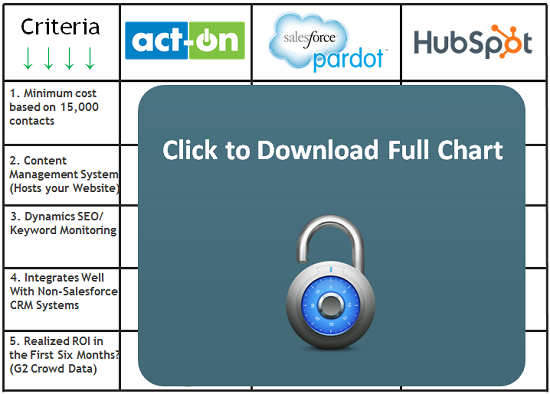
UPDATE: Download the Product Comparison checklist: Hubspot vs. Pardot
We’ve been getting requests for product comparisons, so there you go! More to come (-=
I’m curious about this too. Several people on LinkedIn were raving about Hubspot – but when queried on what was so great or the expected ROI they all went strangely silent. WordPress is free, content drives traffic, form collectors are cheap.
What piece of the link am I missing that Hubspot provides? If I need additional landing pages Blogger, WordPress.com and about a half trillion others will take my $10/year and give me a domain and a blog…
We use Hubspot, but are only paying $250 per month = $3000 per year, not $9,000. We went to Hubspot because we had a static web page that required us to contact the developer to upload new content, which was too last-century. For us, Hubspot provides the content management system, blogging, analytics and conversion tracking all in one place, and we didn’t have any of it prior to moving to Hubspot.
The main thing for me is that its content mangement system is really easy to use – so that administrative (not technical) staff can make graphics and layout and text changes often and work on our SEO keywords, etc. Saves a lot of money there.
I don’t think it would be worth $9,000 per year to me, but it is worth $3000.
Hi all – a HubSpotter responding here with a few additional data points so you can decide for yourselves:)
Beyond just tools to help you get found – optimizing all your content for search engines & social media, HubSpot’s landing pages can not only kick of tailored lead nurturing campaigns, but can provide you the tracking of that traffic and lead to a sale (unlike Google Analytics). Because HubSpot’s more expensive products also offer integration to third party websites, Salesforce.com and even other CRM systems (HubSpot Large) – you get end to end inbound marketing unlike anywhere else. Pair that with education and advice that is second to none and you become a rockstar marketer with real results to show your sale team and CEO.
In terms of ROI, our customers tell our stories best. A few snippets and links to their stories are here:
-The average HubSpot customer has 4.2x more leads after 5 months of active use
-About half of our case studies share how much they are saving in PPC by ranking organically – in most cases, they are saving more than 3-5 times the cost of their monthly HubSpot subscription price.
Check out http://www.hubspot.com/roi for our most recent ROI study and then review a few of our customer case studies (we publish a new one about once a week) at http://www.hubspot.com/customer-case-studies/ctl/all-posts/
If you have any questions – don’t hesitate to ping me on twitter @kirstenpetra
Looking forward to seeing what others have to say!
Thanks for the feedback! Perhaps we need to do a better job showing people all the cool things in the product. One stat from an MIT study we commissioned: HubSpot customers get 4.2 times more leads after 5 months using HubSpot.
After having read your article, if I were try to sell you HubSpot or show you the value that you are trying to find, these are the questions I would ask:
Google Analytics can track your web traffic, but do you have real marketing analytics? Do you know how many _customers_ came from Social Media vs SEO vs AdWords vs other sources? Can you easily see what % of your traffic came from social media in aggregate?
Can you segment your leads on all the data in your database and email each segment without importing/exporting?
Do you have data that tells you which keywords you should target for SEO?
Can you easily create multiple lead nurturing campaigns to follow up with leads?
Can you see what companies are visiting your website and have not yet converted?
Can you easily (no programming) create landing pages to convert more visitors into leads?
Can you monitor conversations in social media, including blog comments and LinkedIn?
Do you know how many inbound links your last blog article attracted?
When you publish a new blog article, does it automatically go to your company twitter account and company Facebook page? Does it automatically go out to the people that subscribe to your blog by email?
Do you know how many Twitter followers you had each month for the last 6 months? How is that number changing? What about Facebook fans? Do you have a report that shows this?
Do you have a way to optimize each page of your website for SEO that gives you a report about what is right and wrong for each page on your website?
When you write a blog article, does your software give you automated feedback on what you need to do to better optimize the article?
When you get leads on your website, does your system automatically find their Twitter name and LinkedIn page and grab a photo of the person and then show it to your sales person so you know a lot more about the lead and what they are up to?
When your leads in your database come back to the website, does your salesperson assigned to that lead get an email alerting them that the lead has come back?
Do you have a way to compare your online presence to your competition and track that over time so you know if you are getting ahead or falling behind?
Do you provide lead intelligence to your sales team that tells them how often the leads visited the website and what pages they viewed?
If you have a problem with your marketing software, is there a phone number you can call and talk to a human being within a couple minutes to solve your problem?
HubSpot helps you do all these things, plus more – we are building an all-in-one marketing system. I guess we need to do a better job communicating that! But that is the answer to your question.
I believe HubSpot is a necessary – but not sufficient – piece of a modern marketing plan. I’ve used it now for 3 years at 3 companies, and about to use it at my next start-up. (A technology start-up’s requirements might be a bit different than what other SMBs need and try to do, so this might not be generalizable for all your readers.)
Early in the start-up’s life, you need to choose marketing and sales platforms. There are a variety of good tools and technologies out there, but I’m extremely partial to a set-up that integrates Salesforce.com and HubSpot. Between these two products, you can quickly and easily build the infrastructure that’ll enable you to have a web presence, get found online, convert visitors into leads, and manage the sales process from start to finish. Marketers will spend much of their time in HubSpot; salespeople in Salesforce.com; and because of the nice integration between the products, you’ll have end-to-end analytics to make better marketing and sales decisions. And depending on what’s relevant for your business, there’s a lot of useful supporting tools/technologies available (e.g., tracking individual clickstreams via ClickTale, or capturing customers’ suggestions via UserVoice).
But Salesforce.com and HubSpot have been (for us) the biggies – because they’re important investments that require commitment, will have a major impact on your business, and have non-trivial switching costs.
Sure, you can weave together half a dozen technologies and services – content management, analytics, hosting, SEO tools, campaign management, salesforce automation, customer support, etc. – and with some custom programming and duct tape get it to work. I’ve done this a bunch of times, both at start-ups, and a $200M/year software co. And having done it, my advice is: DON’T. You risk spending too much time and money connecting disparate systems, customizing, and inevitably running into limitations – and every second of that will take away from marketing and selling.
Regarding the financial aspect of your question: I think $9K is a lot, though it’s really a drop in the bucket relative to what you probably ought to be spending. HubSpot’s a nicely integrated set of tools, utilities, etc. – but without a real commitment from a small team, it’ll be money wasted. And that real commitment will cost a lot more than $9,000. So the real question (I believe) is more like, “Are we willing to spend $50,000-$100,000 this year and make a bet on inbound marketing?” Most of that investment is around creating content – efforts by you, your team, perhaps an occasional journalist to help create content, a contractor to help make a video. Really, it’s one or two full-time-equivalents worth of effort. If you’re not in a position to invest that, then don’t bother with automation.
For example – at one of my start-ups, we had just 10 people – and everyone contributed something, from the CEO, to the engineers, summer interns, etc. Some people contributed once every few months; others monthly; the CTO and I on a weekly basis; and collectively that was enough to really move the needle. And that investment was a lot more than what we spent on the SFDC/HubSpot infrastructure. Without HubSpot and SFDC, we would have been much more clueless about what’s working, where to invest more, and how to have a pretty smooth closed-loop marketing/sales process, managing hundreds of thousands of visitors, thousands of prospects, hundreds of accounts.
When HubSpot first came out (and had less features and was cheaper), I used to say that it’s a nice set of vitamins – each of which is useful, but not very difficult to find elsewhere – and that it was mostly an elegant way to bring it together. Now, 3 years later, the product has become indispensable. I have not seen an alternative with remotely the same:
1) feature set;
2) integration with other products.
3) ease of deployment/maintenance/growth. And this one’s a biggie – easy to get going, and a ton you can do with it.
(Maybe a longer answer than you hoped for? Sorry ’bout that…Bottom line – my sense is that $9K is not trivial but the value is overwhelmingly there, if the rest of the marketing plan leverages the infrastructure investment.)
Thanks so much for the comments everyone! Mike, you make some great points that had been overlooked. But when will Hubspot have a SugarCRM integraion!?
@Sonja,
RE: SugarCRM
So – we just launched the HubSpot Leads API a few months ago. Since then, customers & Certified Partners have been hard at work on all CRM systems. We’ve got one customer who is live with Sugar now – using their own integration via the API. We are working on some efforts to create a more ‘out of the box’ version and hope to be able to share news soon.
But – if you have a developer who knows Sugar – then let’s get you connected with your CSM and figure out if you can use the API to connect your system up ASAP!
Though not a Hubspot user, we seriously considered it. Is it worth it? Like most questions relating to complex solutions the answer is it depends.
That said, if you:
-Are new to online marketing (less than 2 years focused experience)
-Sell a high value product where leads also have a high inherent value.
-Are launching or in a relatively new company
-Lack staffing resources and online marketing specialist (SEO, PPC, Social, Analytics…)
-Want to get things rolling quickly on all fronts
You should take the time to evaluate this solution, it can be worth many times that price.
Also avoid A/B price comparisons in this area, focus on impact to your business. This can be a highly leveraged solution that can have a big impact so a difference of a couple thousand on the front end is nothing relative to the benefit… or pain you’ll recieve down the line.
On the other hand, if you have some serious online experience under your belt, have a WordPress blog running the Thesis theme, are using Google Analytics, then you should also put solutions like Pardot, Eloqua, and Marketo into the mix.
Even if you don’t go with Hubspot, spend some quality time on their site. They are very good at what they do, and share some great information on their site (Marketo does as well).
I consult for a company that uses Hubspot, and I just can’t understand why they pay so much. The feature that they LOVE is lead tracking… You can do this for pennies on the dollar from companies like RhinoSEO or download a database template from codecanyon.net. As a 6 year SEO/Marketing consultant, I really can’t see the value and I hope they dump this service sometime in the near future.
Thanks for your comment!
BrainSell has been working with Hubspot on and off for almost a year now and I’ve really started appreciating the value. The landing pages save us a tremendous amount of time. And now the SugarCRM integration brings it full circle. All of the people who fill out a form on Hubspot are created in Sugar as a lead. I’m not in several systems now. It’s all there in one place. And we’ve dropped PPC entirely, so Hubspot is less money than that bill was. That’s our next blog series. I guess we’re converts now (-=
Sonja, thanks for posting this. HubSpot’s doing a great job as an industry leader, and although I haven’t personally used their product, I do know and understand the features they provide, and they have a large number of success stories. If we didn’t have our own inbound marketing platform, I’d recommend them
Our inbound marketing platform (Spectate) is different from HubSpot. Spectate integrates with WordPress, but allows you to use any CMS. We also offer free trials, there are no annual contracts (we charge month-to-month), and we don’t charge any implementation fees – Spectate.com.
Thanks Eric! I hear you have a partnership with Pardot too?
Hello all-
This blog caught my eye as we are trying to put together an ROI database based off of local businesses experiences with various internet marketing tools. Does anyone have specific metrics in their experience with HubSpot? We have heard good things but would love to have some specific ROI stories submitted.
Thanks!
Hi Dan,
Yes, Hubspot does a great job with that. Here is their ROI page… http://www.hubspot.com/roi/
Relative to the cost of salesforce it seems reasonable. Given both can service important parts of the marketing and sales funnel it is really a case weighing up the specific ROI to your business.
If budgets are tight then most of this can be achieved with landing page tools and hooking up to a lead tracking tool.
Relative to the cost of salesforce it seems reasonable. Given both can service important parts of the marketing and sales funnel it is really a case weighing up the specific ROI to your business.
If budgets are tight then most of this can be achieved with landing page tools and hooking up to a lead tracking tool.
Hey, this has been a really helpful dialogue for me. Thanks for getting the conversation started, Sonja.
I work for a small non-profit camp and conference center and we’re looking at going with HubSpot to help us pull together a lot of these pieces in the marketing/sales realm.
One thing that I’m really drawn to as a one-man show is the integration of all the tools in one place. We want to create fresh and valuable content, optimize it, provide tools to share it with, track who’s consuming it and be able to nurture a greater number of these leads.
I know I can pick up many of these disjointed pieces through free/cheaper sources, but I’m not sure what time that leaves me for the act of creating more/better content.
Beyond that, we’re still already paying $500+/year for email marketing (covered with HubSpot) in addition to money for site hosting, blogging software, a form service, etc.
We could drop the same amount for a magazine ad or some other outbound campaign that would have a far smaller ROI.
Am I missing something? It seems like for a small business (HubSpot’s non-profit discount is a real bonus, too), this is a no-brainer.
Hi Brian,
Thanks for your input! I experienced the same thing. We tried not to use Hubspot for a while and I used SO much time jumping from one social site to another. Not to mention the hours wasted putting up landing pages on our FTP site and dealing with that mess. The landing page/form builder are worth the subscription fee alone!
If you need any tips on administering Hubspot, call us Brian! It’s even better when you sync it with CRM to automatically assign and transfer leads. We love it!
Thanks, Sonja.
I’ve had Hubspot for several years but am looking to try something different. One reason is that it always leaves me hanging when I try to get into the details or do deeper analysis.
I think for some people, Hubspot’s integrated solutions are a plus. I suggest being as thorough as possible in doing a demo.
Thanks for your input JJ! What do you find is lacking? There are going to be some pretty big improvements in Hubspot coming up, hopefully they’ll be covered!
Im waiting for Hubspot to deliver a free Microsoft CRM tool — currently its an expensive exercise to integrate the two
Check out VisualVisitor.com. Better than Leadlander, easier to use than Hubspot. 400% less expensive. VisualVisitor is only $39/month.
Thanks for the info Ryan! We were just at a conference with Hubspot and they have lots of great product updates coming out in May. Excited to see what they have to offer!
I’m getting more and more familiar with Hubspot, and I’m grateful for what I’ve learned. I didn’t know anything about inbound marketing and social media before Hubspot.
Now that I’ve learned the basic elements of inbound marketing, I’m starting to wonder if I can conduct social media campaigns without Hubspot at first. I think that I would like to generate traffic first without Hubspot. After we’ve gotten a few sales through inbound marketing, switch back to Hubspot to increase the reporting and automation capabilities.
From what I’m seeing in Hubspot, the following can be done without HubSpot pretty easily:
1. Search the internet to learn what people are talking about.
2. Write articles and link your articles to their discussions. Post links to the blog in my social media accounts.
3. In each blog page, add CTAs / links to landing page forms to get their contact info
4. Use excel to track and send e-mail drips to those who fill in the forms
5. Repeat steps 1-4 above to get more and more contacts. Some of the contacts will turn into leads.
I know that without Hubspot, I don’t have access to a lot of the reports. However, with our small marketing budget, I wonder if I should just generate traffic manually first. Then once I have enough leads, upgrade to the Hubspot solution, so that we can increase automation and get more access to reports.
Thoughts? Am I missing a big component to what Hubspot is offering?
Micky
Hi Micky,
Thanks for your input! I tried to do it all manually when I started at BrainSell 2 years ago and it was VERY annoying. Building landing pages was the biggest plus of Hubspot for me right off the bat. It too forever for me to build a new page, and then the form responses were not logged in a central database. They had to be manually entered into CRM, which is prone to human error.
So for me it was…
1. Landing page and form building
2. Sync with CRM
3. Automatically tracking leads
4. LEAD SCORING
I was so psyced to see people return to the site, we stopped spending as much time on leads that dropped off our site and more time on the people who CARED. Drip marketing is also something we’ve graduated to and it’s a wonderful way to convert prospect without much intervention. Just set it and forget it.
If you have a small marketing budget and team, I find Hubspot is a GREAT investment, it was like hiring a whole other person, but MUCH less expensive.
The team = me, at this point.
I guess since my membership is around $3,000/year…maybe it is saving me time…
hard to tell, since I come from a web design background and could duplicate landing pages and new custom forms in a few minutes. Hmmmm….
Thanks for the input…
Hubspot has created a cult like following and produces some amazing content.
Their software is pretty powerful and automates a lot of tasks- but it is important to understand what you really need. I am biased however towards Optify.
Optify is a similar marketing suite providing tools around:
Increasing Discoverability (SEO and Page optimization tools, social marketing tools)
Optimizing Lead Conversion (Real-Time traffic analytics, Form and Landing Page builders)
Gaining Transparency into marketing efforts (Closed loop marketing with digestible analytics and reports)
Easy Integration with CRM (seamless data transfer plugged into what your sales team uses everyday!)
And the best part, you don’t have to pay an arm and a leg for it. http://www.optify.net
Hope this helps!
The amount of information in here is stunning, like you practically wrote the book on the subject. Your blog is great for anyone who wants to understand this subject more.
Thanks so much!